
Investigate
Threat hunting across agents and techniques.
Analysts can filter events, examine alert levels, compare activity across agents, and use MITRE ATT&CK mappings to follow meaningful leads.
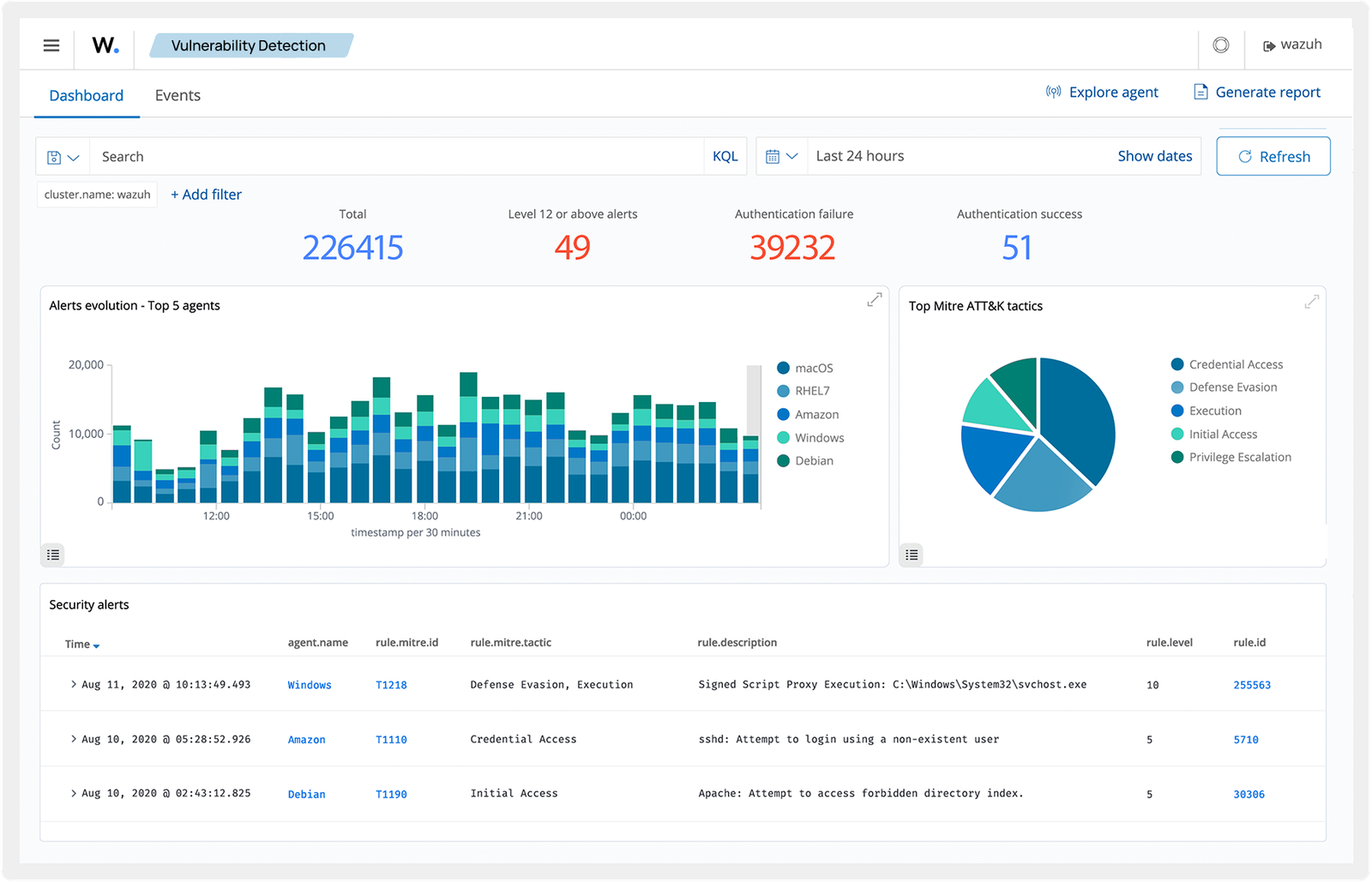
Wazuh Gold Partner · Platform overview
Wazuh brings XDR and SIEM together in an open-source security platform. It collects and analyses security data from endpoints, cloud workloads, networks, applications, and third-party services so teams can detect threats, investigate incidents, automate response, and support compliance.
Platform overview
A unified analyst workspace connects endpoint security, threat intelligence, security operations, and cloud monitoring. Teams can move from asset posture and inventory to investigation and response while working from one consistent view.
Wazuh platform descriptions and screenshots are reproduced or adapted with permission for Al-Rasedah Technology as a Wazuh Gold Partner. View the official platform overview.
Capabilities
Wazuh groups its functionality into a set of security use cases. Each one is a capability you can switch on and tune to your environment.
Checks system and application settings against hardening policies and flags drift from your baseline.
Looks for malicious activity and indicators of compromise on monitored endpoints.
Watches files and registry keys for changes to content, permissions, and attributes, with an audit trail.
Log analysis and visibility mapped to the MITRE ATT&CK framework so analysts can pursue leads.
Collects operating system and application logs and analyses them against detection rules.
Correlates your software inventory against CVE data to surface known flaws.
Active response actions that can run automated countermeasures when a rule fires.
Controls and reporting that support frameworks such as PCI DSS, NIST, HIPAA, and TSC.
Builds an inventory of applications, processes, open ports, and hardware across your estate.
Monitors Docker hosts, images, volumes, and container behaviour at runtime.
Integrates with cloud providers to detect misconfiguration and security risk.
Covers cloud and on-premise workloads across AWS, Azure, GCP, Microsoft 365, and GitHub.
Capability descriptions summarise the Wazuh platform's documented functionality. Which capabilities apply, and how well they perform, depends on architecture, configuration, and tuning.
Extended detection and response
Wazuh XDR combines telemetry from endpoints, networks, cloud workloads, applications, and third-party APIs. This gives analysts one place to detect, analyse, investigate, and respond across multiple layers of the environment.
Analysts can filter events, examine alert levels, compare activity across agents, and use MITRE ATT&CK mappings to follow meaningful leads.
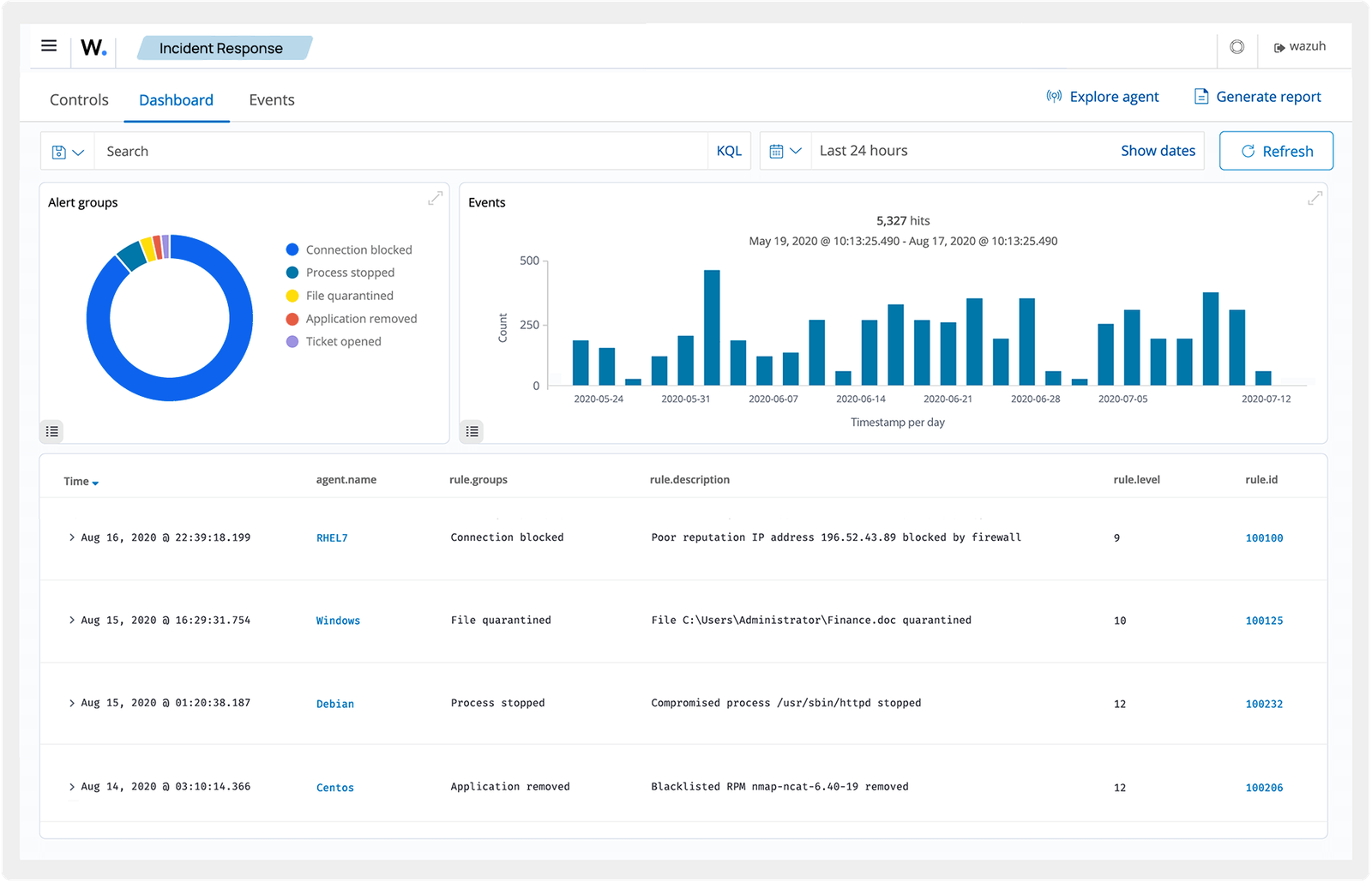
Use rule-triggered actions to block or contain a threat, with every response recorded for investigation and review.
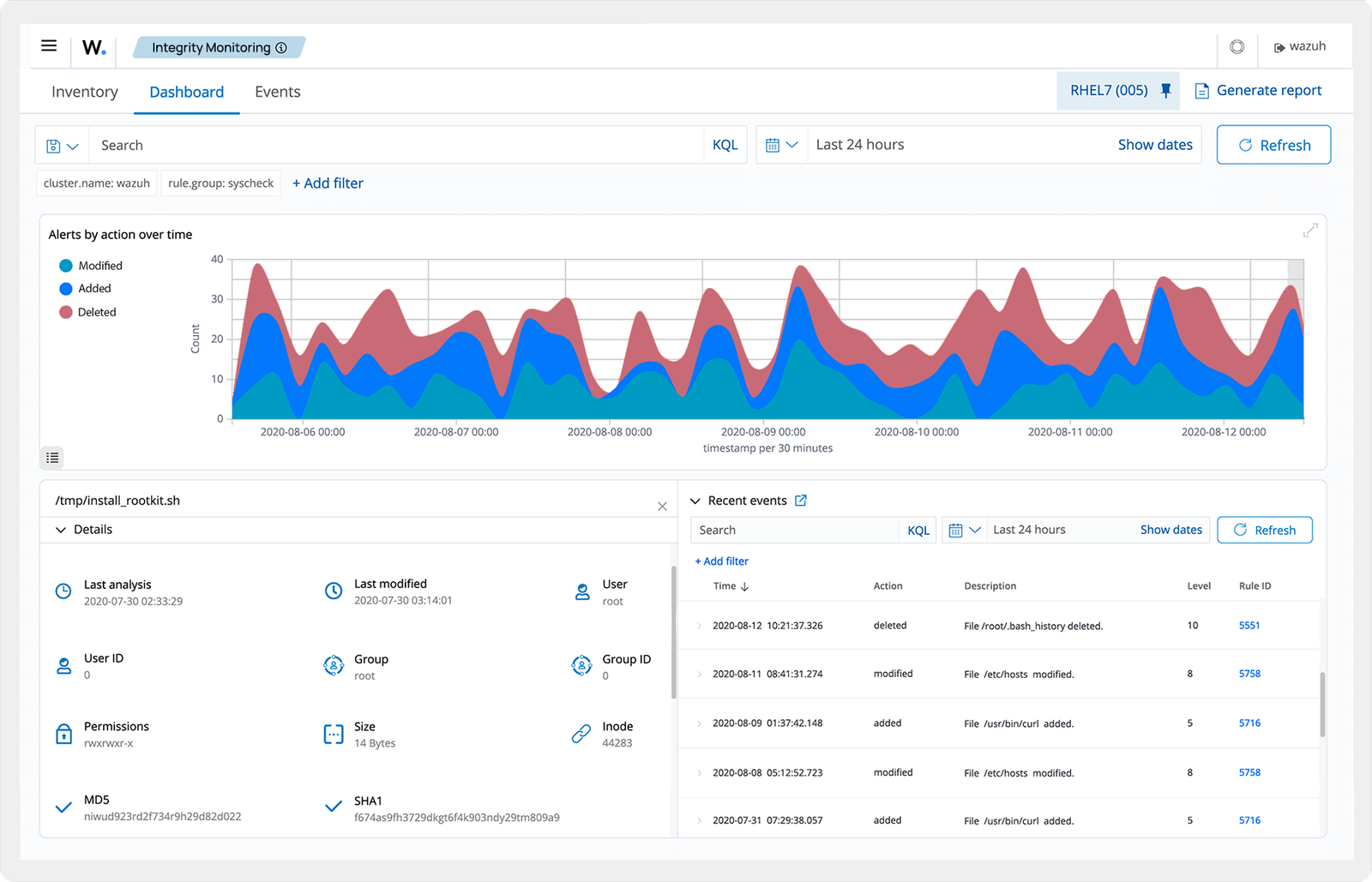
Track file and registry changes with the affected path, event type, rule context, severity, and audit trail in one view.
Use one multi-platform agent for malware detection, file integrity monitoring, endpoint telemetry, vulnerability assessment, configuration scanning, and active response.
Ingest and consolidate telemetry through syslog and APIs from security products, devices, cloud platforms, applications, and SaaS services.
Inspect, customise, and extend the platform to fit your architecture, detection requirements, and wider security ecosystem.
Security information and event management
Wazuh SIEM centralises security telemetry from endpoints, network devices, cloud workloads, and applications. Events are aggregated, stored, enriched, and analysed to support threat detection, investigation, response, and compliance.
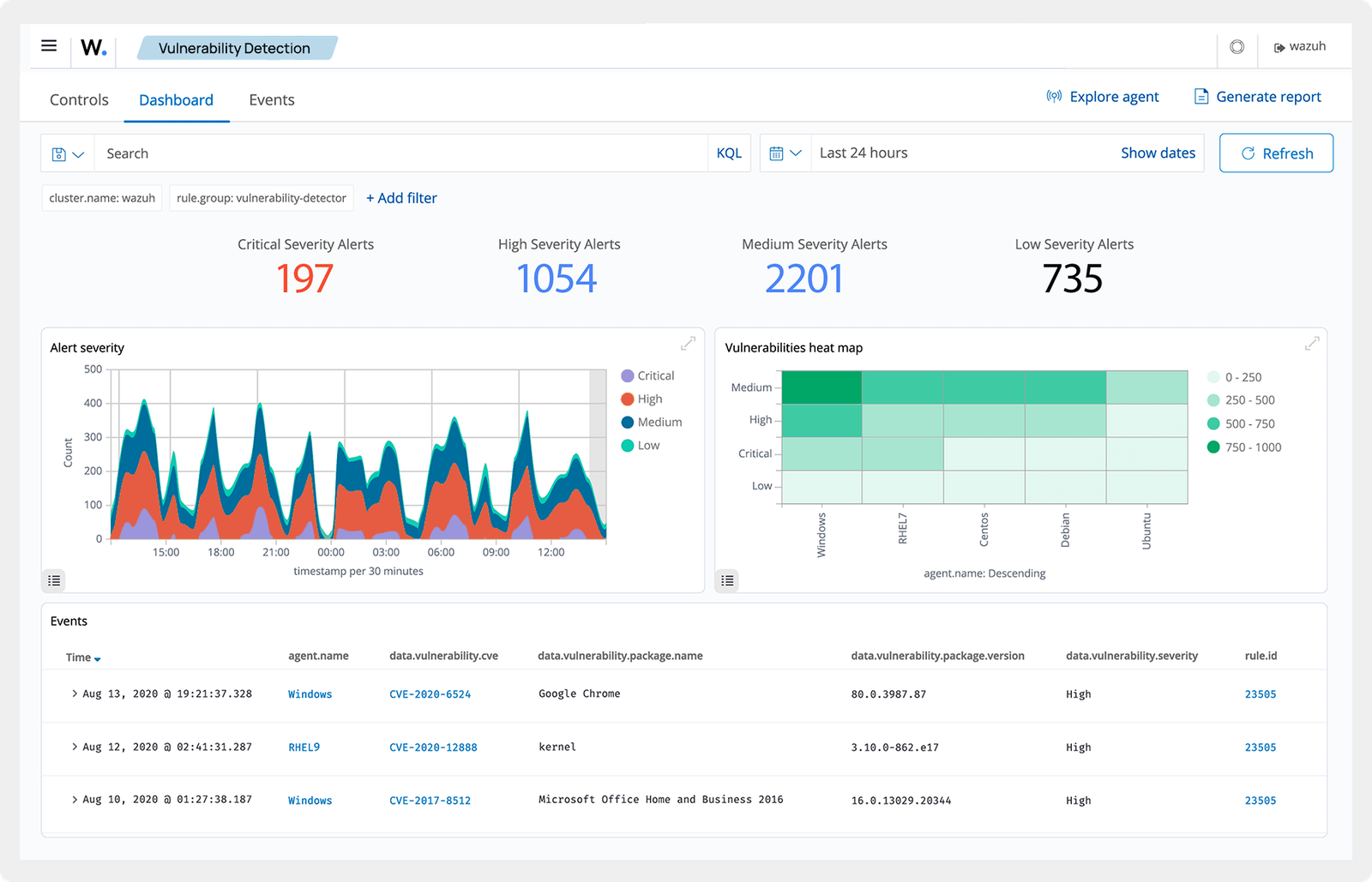
Correlate software inventory with vulnerability intelligence, then break exposure down by severity, operating system, agent, and package.
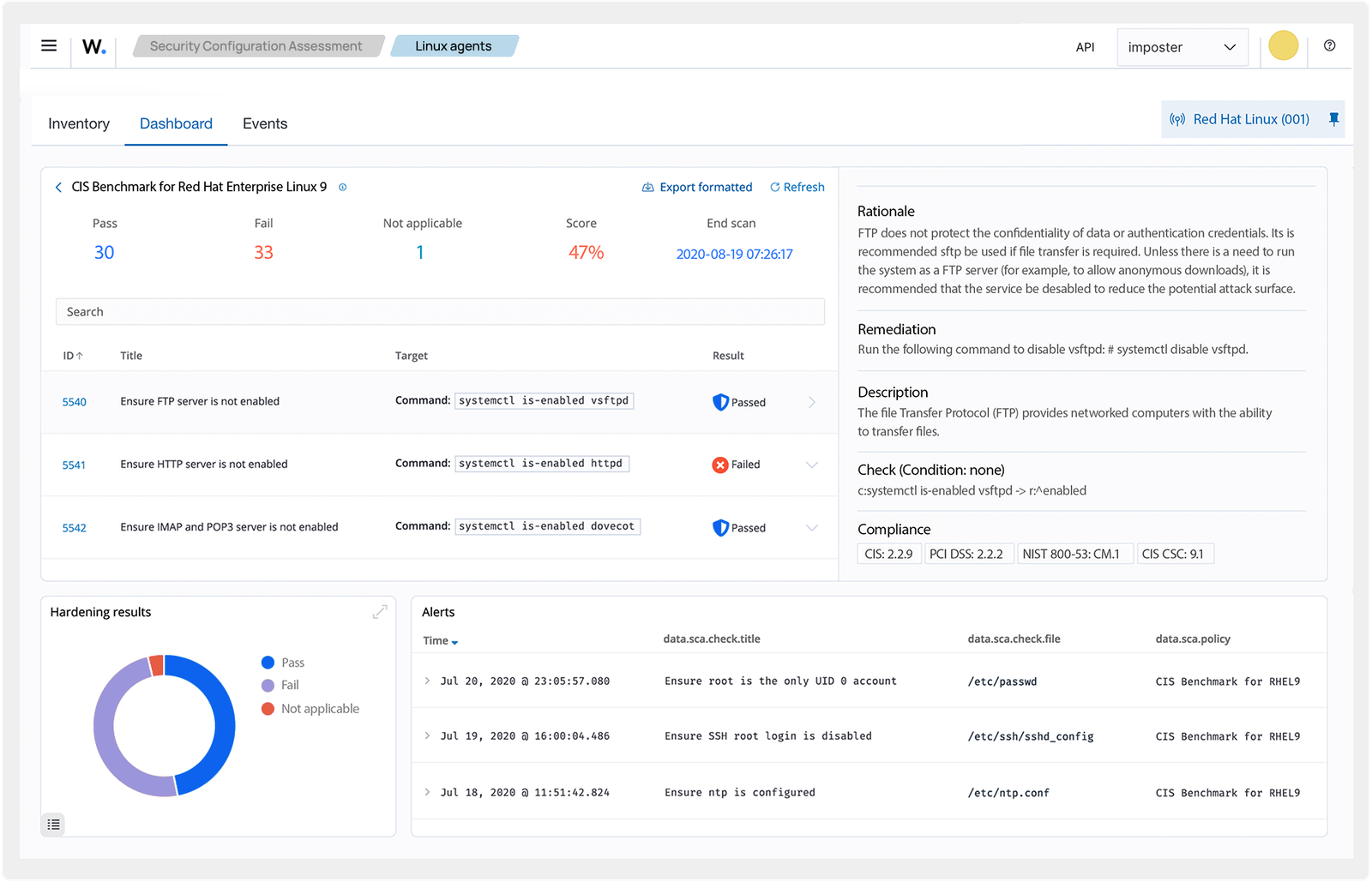
Evaluate systems against CIS benchmarks, review each failed control, and give remediation teams the command or registry context they need.
Correlate events from multiple sources, add threat-intelligence context, and deliver customisable alerts that help teams respond quickly.
Turn SIEM events into clear reports for management, investigations, remediation tracking, and evidence across relevant security standards.
Official Wazuh product screenshots are shown with permission. Dashboard data is illustrative; results vary by scope, data sources, and configuration.
Architecture
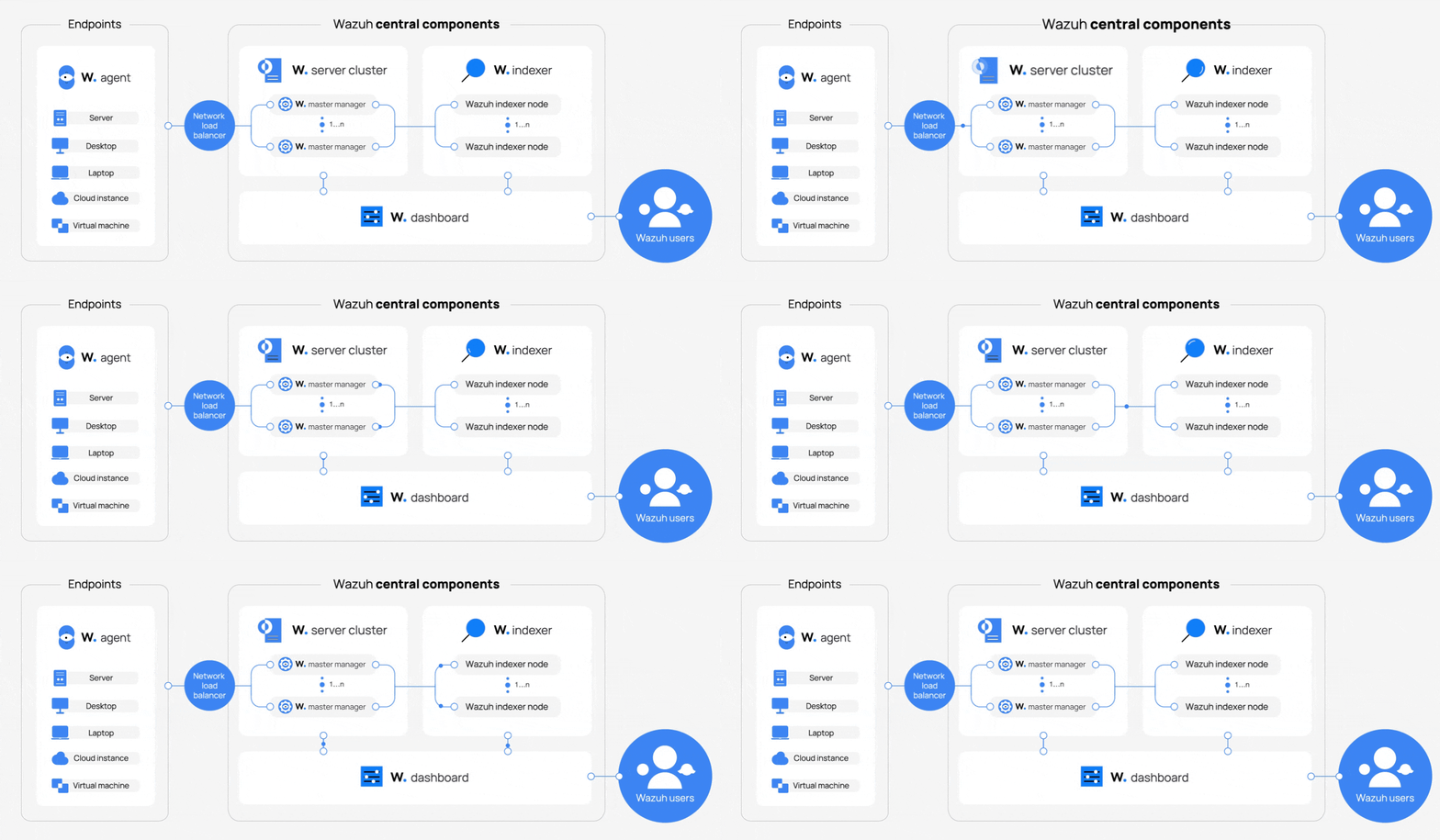
Agents installed on your endpoints ship telemetry to the central components, which index it, analyse it against rules, and present it for analysts.
Monitored endpoints
The Wazuh agent runs on Windows, macOS, Linux, Solaris, AIX, and HP-UX. Agentless collection covers network devices and cloud APIs.
Central components
Deployable on Docker, Kubernetes, Ansible, or Puppet — self-hosted on infrastructure you control, or on an official hosted service.
Services
Assessing the right fit — client-managed cloud, on-premise, or an official hosted service — based on your requirements.
Installing, configuring, integrating, documenting, and validating your Wazuh environment.
Improving rules, decoders, dashboards, tuning, and detection validation within an agreed scope.
Defining support needs and operational responsibilities without overstating service levels.
Architecture, log-source integration, agent onboarding, dashboards, and operational readiness.
Hands-on training for managers, analysts, and the teams who will operate Wazuh.
Value
Al-Rasedah focuses on the engineering layer around Wazuh: architecture, useful data, tuned alerts, documented rules, analyst workflows, and decision-supporting reporting. We don't just stand the platform up — we make it detect.
Assessment
We can review architecture, agent coverage, alert quality, log sources, dashboards, operational gaps, and improvement priorities.
Wazuh is commonly used for both SIEM and XDR use cases, but the accurate description depends on architecture, integrations, operations, and team responsibilities.
No. Wazuh provides a platform capability. A SOC requires people, processes, escalation paths, tuning, reporting, and continuous improvement.
No tool guarantees compliance. Wazuh can support compliance-related visibility and reporting when it's configured and operated correctly.
It means you work with a team recognized by Wazuh, with direct platform expertise — combined with our own detection engineering, so the platform is tuned to your environment rather than left at defaults.
Why open security technology
Choose an architecture that respects operations, privacy, hosting, and governance.
Build on a platform you can inspect, document, extend, and evaluate.
Extend detection, integrations, and workflows as your risk and business evolve.
Keep a documented exit path instead of a closed operational dependency.
Direct budget toward engineering, operations, and outcomes — not just licenses.
Open technology does not deliver privacy or security automatically. Secure outcomes depend on architecture, configuration, maintenance, access control, monitoring, and capable operations.
Download the services brochure.